
Interview with Filth Is Eternal
(Harsh) vibes and stuff

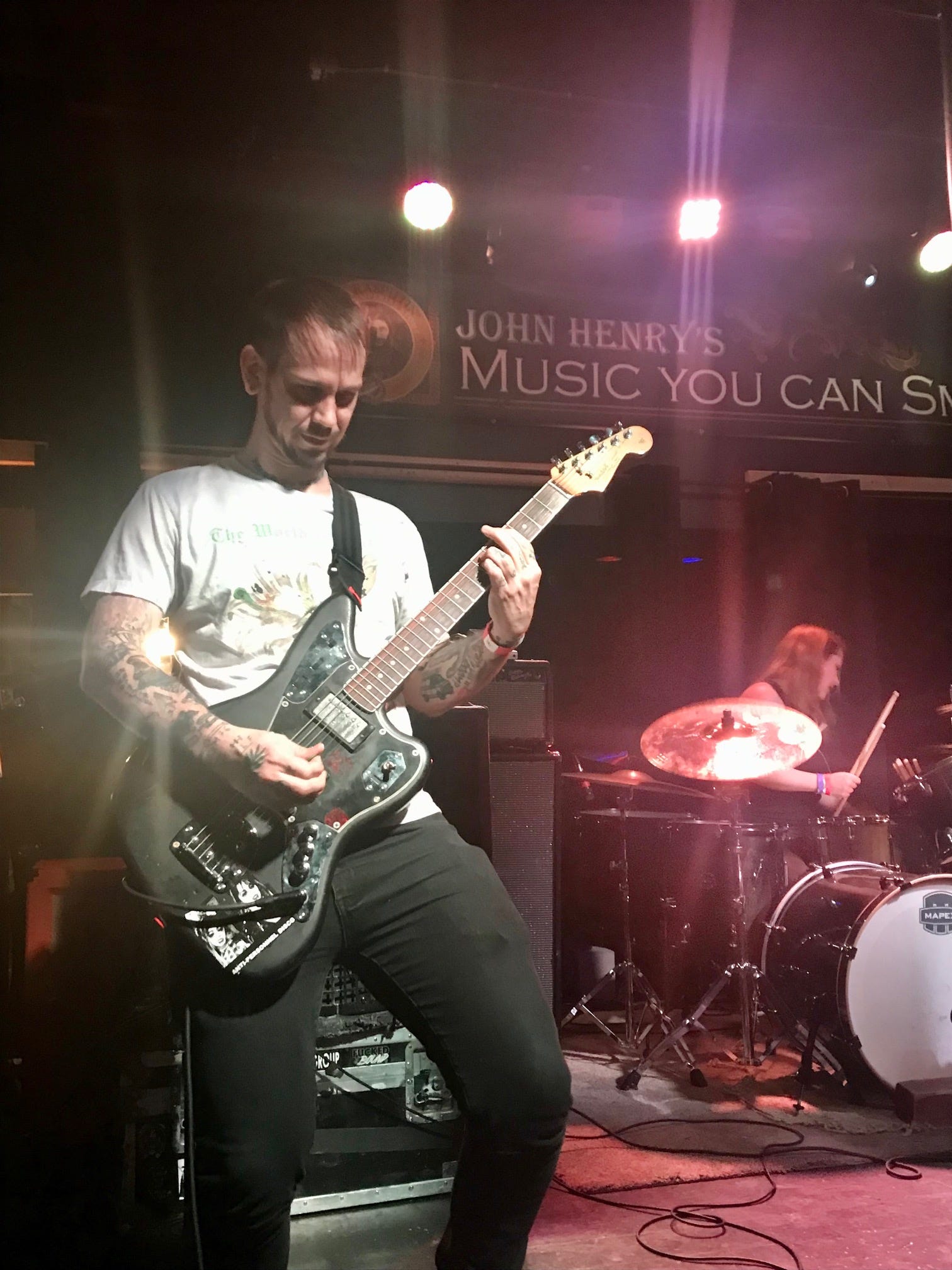
Filth Is Eternal, Eugene, OR 2024
Speaking with Brian McClelland, guitarist for Seattle rippers Filth Is Eternal I feel a bit bewildered how a person who helps create such volatile and nihilistic music can be so goal-driven and focused on furthering his creative expression. A lifelong DIY’er Brian found a similar drive in vocalist Lis DiAngelo and the two began making art and music, and helping run an all ages space for years as their band Filth Is Eternal took off.
Now, coming up on their third LP as Filth Eternal (fourth if you count in the record under their previous moniker) there’s hope and inspiration to be found amongst the nihilism. But as our conversation developed it becomes clear to me there has been a glimmer of optimism all along. It’s that idea of making art in the face of every blockade the world puts in front of you and making it happen despite the odds. They call their new record “Impossible World”, which could easily be misinterpreted for a frustrated resignation from hope. Instead, it’s a call to make a dream reality.
Did you come up in Seattle? Is that where you are originally from?
I’m actually an Albuquerque transplant. I grew up in the desert and I got sick of the heat. We were lucky enough to have a killer art punk scene out there though. I got inspired really early on to be about DIY and community art stuff. So I went to school in Albuquerque and got into the whole ‘do what you can, book your own tours’ kind of vibe and then moved to Seattle in 2008.
Lis (DiAngelo, vocalist) had lived all over California, and then was in Portland for awhile before moving up to Seattle in 2008. Then we connected and started playing music together. We’ve been doing it ever since.
Is that where you first started playing in bands? In Albuquerque?
I started in Roswell. I started booking shows when I was 13. We had a venue out there that was a converted, abandoned airport called the Unity Center. That was one of the only places in the city where you could just go and play, and book your friends bands. We started learning about the regional touring circuit and DIY. That was one of those after-school vocational places where we had a wood shop and a lab, and you could just set up shows with your friends, and book them for the weekend for whoever was rolling through. That really got me started.
And in Albuquerque we had a really strong DIY scene. It was difficult to tour out of there because it was so far away from everything but that led to a really active scene within the community, and was really supportive for the bands that did come through. I was always really thankful for that. But I wanted to get somewhere that was a little more centrally located, I thought, but Seattle is pretty far away from a lot of stuff too!
It’s definitely tucked away. The Pacific Northwest is it’s own bubble. It’s really cool that you mentioned this DIY space you had in Roswell because I definitely wanted to ask you about Black Lodge and your involvement with that. It sounds really parallel, these two spaces, in a lot of ways. I also don’t know the origins of Black Lodge, but I know it’s been very important to the DIY scene in Seattle, and you and Lis have had a lot of involvement with it?
Yeah! Black Lodge was started by a collective of punks and we joined about two years in. So there was a team of people in the Black Lodge collective that had formed the space, and built it out. They dealt with the initial city permits. At one point the building inspector came in and gave them a bunch of shit because they had built out a second floor, where there are still practice units in the Black Lodge space. The city told them they had to tear down the whole second floor and re-build it a half-inch higher. It was one of those things where you feel like they were just hazing the punks. (laughs)
But they built it back up to specs as best as they could and then started throwing shows. And then myself and Lis became active in our bands, and we were offered to join the collective so we jumped on it. We moved in and were living at the space, and booking shows.
At the height of our involvement we booked about 50 shows a year over the space of a few really busy years. But we were supporting a bunch of the shows by just doing sound, running the door, connecting friends, trying to get people in. We lived at that space for 10 years.
Wow!
It’s still active as a practice space. But now the shows that are run as Black Lodge are run in a space next door to it that was previously known as Lo-Fi. So it’s cool to still be a part of it, and a part of that building. We still practice there, and I made merch there for years. We’ve shot our music videos at the Black Lodge space. So it’s very near and dear to us. We love it a lot, we really appreciate that it’s still able to keep going.
For sure. So that brings me to two ideas. The first is that people checking this out may be familiar with the idea of a community sort of DIY space in different cities. But people may not fully grasp how difficult that is to maintain in a place like Seattle where real estate and rent is incredibly expensive. The only parallel I can think of would be maybe ABC No Rio in NYC in terms of longevity of a DIY space and increasingly expensive rent. So I’m sure you encountered that at one time or another helping to operate Black Lodge.
Yes. Part of it that’s really interesting is that when Lis and I moved in to the space to live there, book shows, and help run the space it was still a partially industrial area. There were still warehouses around the neighborhood that were used for the newspaper industry. And over the course of us living there we witnessed Amazon buy up a billion dollars worth of real estate in the neighborhood and just bulldoze block by block and come up the hill towards us. Even on the same block that we’re on they tried to re-develop and that neighborhood was bought up, and up-zoned, and added multi-story, multi-unit apartment complexes. But for whatever reason the block that we’re on the previous businesses had done something with the land where there was an environmental component that had to be accounted for for re-development.
As funny as that is we had every real estate developer come sniffing around and literally knocking on the door. There were times I was literally in the middle of some art project and I’d open the door in my underwear and there’s some squad of clipboards out front asking questions. I’d tell them, ‘I don’t know what you want, but you’re probably not going to get it.’ And the reality was the facility was not what they needed, and they couldn’t do what they wanted with it, and we lived in that grey area where we just kept making art confrontationally the entire time, playing music at 200 decibels straight at the apartment complex across the street because we were there first. And I think you kind of have to carry that attitude- we’re going to make art in the face of everything. You want to come and take it? Come and take it. We’ll find somewhere else to do it and we will do the same thing.
That’s a little less adventurous of an explanation about why it stayed. My second thought on Black Lodge has to do with the explanation I had heard, and perhaps this is rumor, is that the owner of the building was offered a lot of money to sell but they refused to and when he passed the building was given to his kids and they also refused to sell. Is there truth to that?
That is correct. We were there long enough to go through a bunch of different phases. The initial owner was someone that we never really met. The owner did know what we were doing and he largely stayed out of the way and let us do what we wanted. There was the Victory Lounge, which we also supported, which was next door and held shows. We would do joint shows with them. And the owners seemed to support all of that, the culture that was coming out of the building. And I thought that was really fantastic.
And then the owner did pass and I believe there was a spouse that had fielded offers. They looked at some offers and fended people off and they said they wanted this art to happen. But then the facility did change hands a couple of times, it went to the kids, and there’s a reality where you want the culture to continue but at a certain threshold I’m sure that bag is hard to not look at, ya know? But there’s other realities about why we’re able to still do the art. I’m just thankful that we still get a chance to do it. I’m thankful for the owners and property people who have supported us. In a way the people who didn’t support us even motivated us in a way to keep going!
So these things are all tangentially tied together with your music, but I figure since this is a Filth Is Eternal interview I probably ought to ask you about your music. So as it stands you and Lis are the only consistent members of Filth Is Eternal, even going back to the previous name Fucked and Bound, as well as your band before that He Whose Ox Is Gored.
He Whose Ox Is Gored had a similar arc initially. It took us a while to find a lineup of players who got the sound and had the time. It’s difficult to live in an expensive city and find people who can do this. Art is expensive to make. So we work with people who want to work and make art. We all want to do what we can. With Ox it took awhile to get the right lineup, and then we had the lineup with Lis and myself, and Mike Sparks and John O’Connell for a long time. Mike Sparks has stayed on and continued to help Filth Is Eternal on and off for years. He’s actually back in the current lineup. It’s been really fun to play with shredders over the years and work with as many talented people as we can, for as long as we can. We can all make the joke that ‘everyone’s a collective’ now. Ya know, ‘Monogamy? In this economy?’ (laughs)
It’s sort of like that with groups of people making art, or bands. But the reality is everyone is working and it’s hard to get the same lineup to go on a tour, or if that tour is expensive and you have to travel across the country. Sometimes you can work from the road, sometimes you can’t because you can’t take the time off and have to be somewhere in person. We’re just happy to work with the team we have that has been able to join us and make this stuff happen. It’s been a real blessing.
So the sound of Ox was quite a bit different than what came next, which was Fucked and Bound, which turned into Filth Is Eternal. Was it a quick transition, going for something different, or one just flowing in to the next and writing a different type of music?
That’s a good question. We had started Fucked and Bound when He Whose Ox Is Gored was still active. So we were working on a second album for He Whose Ox Is Gored at the time when we had put out our first 7” for Fucked and Bound, and we were writing that first album “Suffrage”. So we put out some of the Fucked and Bound stuff that turned into Filth Is Eternal. With He Who Ox Is Gored, we were having a bit of trouble connecting with the labels we worked with for support to finish the second album. We had been doing that band for about 10 years and we were in and out of the studio, Lis was doing some touring with other bands, and we just couldn’t quite get the support that we needed to complete that second album.
But at the same time I’m always writing. I’m always writing for whatever I want for whatever and it just goes into different buckets. There’s crazy textural art-based progressive stuff. I do ambient music. I make hip-hop beats under my BTOWN moniker. So I just like to create and work on different stuff.
So we were trying to do the Ox thing, but we had Fucked and Bound going. And when Ox sort of dissipated and the lineup couldn’t sustain we just moved over to a different project where we could just keep moving.
And I think that’s what you see with different bands- the desire to create is to be like water, go where there is least resistance. Just do what you need to do.
That’s a good analogy. With that in mind, is that what precipitated the name change from Fucked and Bound to Filth Is Eternal: something with less resistance, or was there enough change within the lineup to feel like a name change was appropriate?
That was an interesting time because Fucked and Bound was not meant to go wide!
Not with that name!
Right. It was some punk shit. We’re all fucked, we’re all bound to a system, we’re all just trying to figure it out. We really didn’t think we were going to last beyond a 7”. But I put out that first 7”, “Live At Black Lodge” and that sold out. We pressed it three different times and each of them sold out. And within the first year I think we played Northwest Terror Fest, we were getting asked to do some tours and other things. We wanted to do as much as we could, but we didn’t think it was really going to go big. So then we did the first pressing of the “Suffrage” album with Atomic Action Records and it was fantastic. It was great to partner with him, I think we were the first West Coast band he put out. I’m not even sure he thought it was going to sell, or go the way it did. It got to the point where we needed to re-press and he was having a hard time keeping up. So we partnered with another label and did some more touring. So it was all cool.
I think part of it is we had some of those lineup changes. We were getting ready to put out our second record as Fucked and Bound and it was during pandemic and we figured out that there was a lot more digital censorship that was clamping down on people. So we said that we wanted to do the best that we can with this material for everyone, and our team had grown to be a couple labels and booking support. So we figured it would just be better for everyone if we just opened it up and do something that people can use with the Filth Is Eternal moniker. So we just switched over to that. It was, again, the ‘be like water’ idea.
But we also got tired of the cyber eye prying into our business where we couldn’t do things, and kept getting flagged for stuff. I was like, ‘just get these nerds off our back!’ (laughs). Let us do our thing.
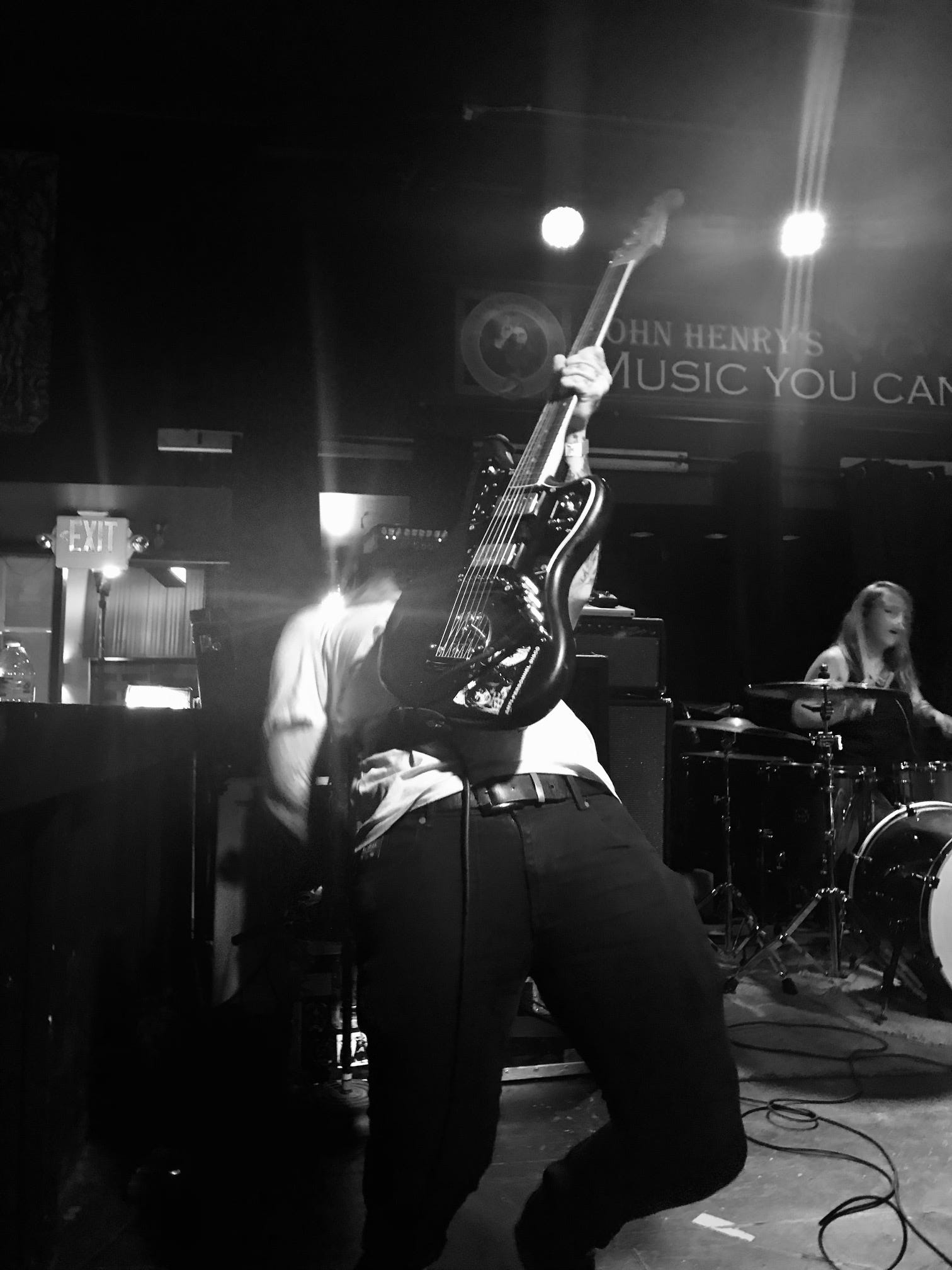
I think that’s where I entered in to your band- through the album “Suffrage”. And when I saw Fucked and Bound play I had to admit, I was kind of scared. It’s very rare now for a band to make me feel like I am in danger, but I enjoy that because that’s a part of why I love punk and hardcore, that slight aspect of danger.
Success!
Right? But at least then Lis was a pretty terrifying front person- going into the crowd, pushing people around, going up on the bar and kicking over bottles and shit, getting very aggressive. And now in Filth, even though it’s still a really engaging and exciting live show, I feel like the confrontational aspect has tapered off a bit?
Yeah, that was something we joked about a lot over the pandemic. Lis would go out into the crowd and push people around and lick strangers and stuff. And that was always hilarious and interesting, that drive to engage with people. If you come to the show we don’t want you to think we’re hiding away in the green room. We’re there to talk to our community and have fun with people. But there is a bit of reality that is funny coming through a pandemic like, ‘OK, maybe we will stop licking strangers’ (laughs)
But that intensity that we’ve gone through has only gestated in a certain way. There’s still a lot of that that Lis carries with a certain stillness. They don’t have to physically push people around. They carry a lot of terrifying vibes where they can just focus on people from the stage. We’ll still come out and knock you around if you want. But we can also just keep the same vibe other ways.
I think, early on, there seemed to be more of a nihilistic attitude even lyrically. I’m not sure how much you can speak to the lyrics but on “Suffrage” there’s a song called “Zero Fucks” which says, ‘what’s the cost of good living when you’re fucked?’ It’s very direct. And I noticed on Filth Is Eternal material it feels a little harder to pin down the lyrical focus.
There’s some of that where Lis and I work on vocals and they write a lot of whatever comes out. But I will also provide things here and there. “Zero Fucks” is one that I worked on early on, so some of that nihilism comes straight from me. I live in the hole a little bit more than Lis does. Lis has some of that same darkness, which is very real and very true. But they’re a little more atmospheric with that. But I think Lis writes some incredible lyrics, and I’m really happy that we have a pretty cohesive way of working together on that. We found ways, over time, to create a lyrically poetic thing. It’s mostly Lis. But we have been able to share in some of those things that motivate and pair with that sound to represent that darkness well.
It’s not to say any of the nihilism is absent. The new album that’s coming out is called “Impossible World” after all. And as I read into it a little bit there seems to be this idea of ‘we can’t have good things’. But maybe you can expand on that a little bit and talk about the new record.
That’s one thing we talk about a lot. There is a dark aesthetic to some of those things. There can definitely be a nihilistic vibe from some of the titles, like one of our records was called “Love Is a Lie, Filth Is Eternal”. People ask us about the darkness of that. But when we talk about “Impossible World” we’re saying that when the world feels impossible you need to make the impossible happen. Sometimes the impossible feels like, ‘man, I wonder if I can live in a world where kindness prevails?’ Well, you can make the impossible happen.
So there’s a duality with that. On the surface it’s dark. But that doesn’t mean that there’s not a light from within that motivates some of that. Sometimes you have to push through the darkness to shine your light. You have to have a positive message to get through all of it, and that’s true.
I think also, some of that darkness comes from a desire for catharsis. Sometimes you got to process those feelings in order to live your life and approach people with love in hard times.
That was way more positive than I imagine your band being (laughs)
But it’s true! There is definitely a darkness, aesthetically, to that. But we’re a very caring group, for real, and a lot of that comes from having to blast some of these feelings out. And that’s where you see the crowd relate to that a lot. We’re very friendly when you come see us, or talk to us. But I think a lot of people understand the desire to pull some of those heavier feelings out of their psyche, do them, and get rid of them.
So speaking a bit to that, listening to this new album there is a lot more melody to it, Lis is actively singing more, a few of the songs have these more melodic leads where as a lot of the older material leaned way more into these Motorhead sort of d-beat charges.
One thing a lot of people don’t know is that Lis is also an incredible singer and vocalist, they can just hit notes and do these amazing harmonies. We’ve been screaming at people for years and we have plenty of that energy. One thing we talk about is that as you play music more, and the more you hone your craft, d-beat gets limiting. Sure, there are variations- you can do Euro style d-beat, or Japanese hardcore d-beat, or American thrash-influenced d-beat. But d-beat is d-beat. So eventually you want to bring in other influences, and we love so many genres of music. We love different types of heavy, we love rock n’ roll, we live in the grunge city. After awhile you want to write some songs. I can give you riffs all day but sometimes I want to write something that you will remember.
You had mentioned a little earlier of music that you write under various monikers and by the sounds of it it’s all very ‘you’ directed. How does it work in a band like Haunted Horses where they’re writing the bulk of it and you’re adding in as a contributor, or working via other people’s direction?
Haunted Horses is like my favorite band. So when we joined together there was stuff that I do for that group that fits in, but I’m happy being a player and an accompaniment guy. That’s another thing that you learn working with different musicians over time- you need to know when to lead to when to follow. Haunted Horses is a group that I always appreciate what they do. They have an incredible aesthetic, the way that Myke and Colin’s minds work, they’re incredible artists in their own right, both aesthetically and sonically. So they will often come up with bass parts and I’ll just play that. There’s really only 5 to 10 percent of the time that gets changed. My role in that group is just to show up, do it, and dial in the nastiest bass tone possible. I’ll also help out with the screenprinting and merch design for them. But largely they know what they’re doing and I get out of the way. That’s one of the rules- when you have a good team you let them do their thing.
The last thing I wanted touch on was that some of the things you’ve been saying about working cooperatively, and having a ‘team’ also butt up against doing your own screenprinting, and formerly living at the practice space. How do you find the balance between acts that are truly DIY and managing as many aspects of your band as possible while also working with folks who are quote-unquote industry people. You have people who book for you, the label that releases your music is a fairly known business. Is there a point at which you cede control, or a line that you draw between those two worlds?
That is a great question. Whenever I talk to people like other musicians, or DIY artists there’s always a question around selling out.
This is a 1997 discussion we’re having right now.
It’s totally true though! The reality is though, it’s hard to make art, and if you can get resources just to make your art then awesome, do that. I put out a lot of the records we did on my own initially. I put out most of the He Whose Ox Is Gored stuff, I put out stuff for Haunted Horses before I was in the band because those are projects that I love. You can learn how to do it, and that’s how I learned- I just put out my own music and working with artists that I thought were incredible. And then, with that knowledge, that became more valuable to labels. So we work with MNRK Heavy to put out Filth Is Eternal and I have a little bit of the business know-how to be valuable to them to trust me with X amount of resources to put a release out. And they luckily get the vibe that we’re doing. There’s been a couple little things like artwork things, and changing the packaging a little bit where the artist side of me only will allow so much. But they are, overall, trusting us with a not insignificant amount of resources to put thing out. It is hard to be in a band, and be on the road, and do these things, and I’m thankful every day to have support in order to do that. And I will tell anyone who is doing this DIY that you can do it DIY. You can do it on your own, you can make packages that work for people that make sense cost-wise, and you can support yourself doing it if you want to get in and learn the business.
I always recommend a book called “Tour: Smart”, by Martin Atkins who was in Public Image Limited and Ministry. He would do a speaking tour where he would teach bands how to hit the road, and make their own merch, and put out their own releases, and that’s what got me inspired, and you can do that too as your own independent artist.