
Interview with Patrick Kindlon of Drug Church
A jack of many trades, yet has admittedly mastered none?

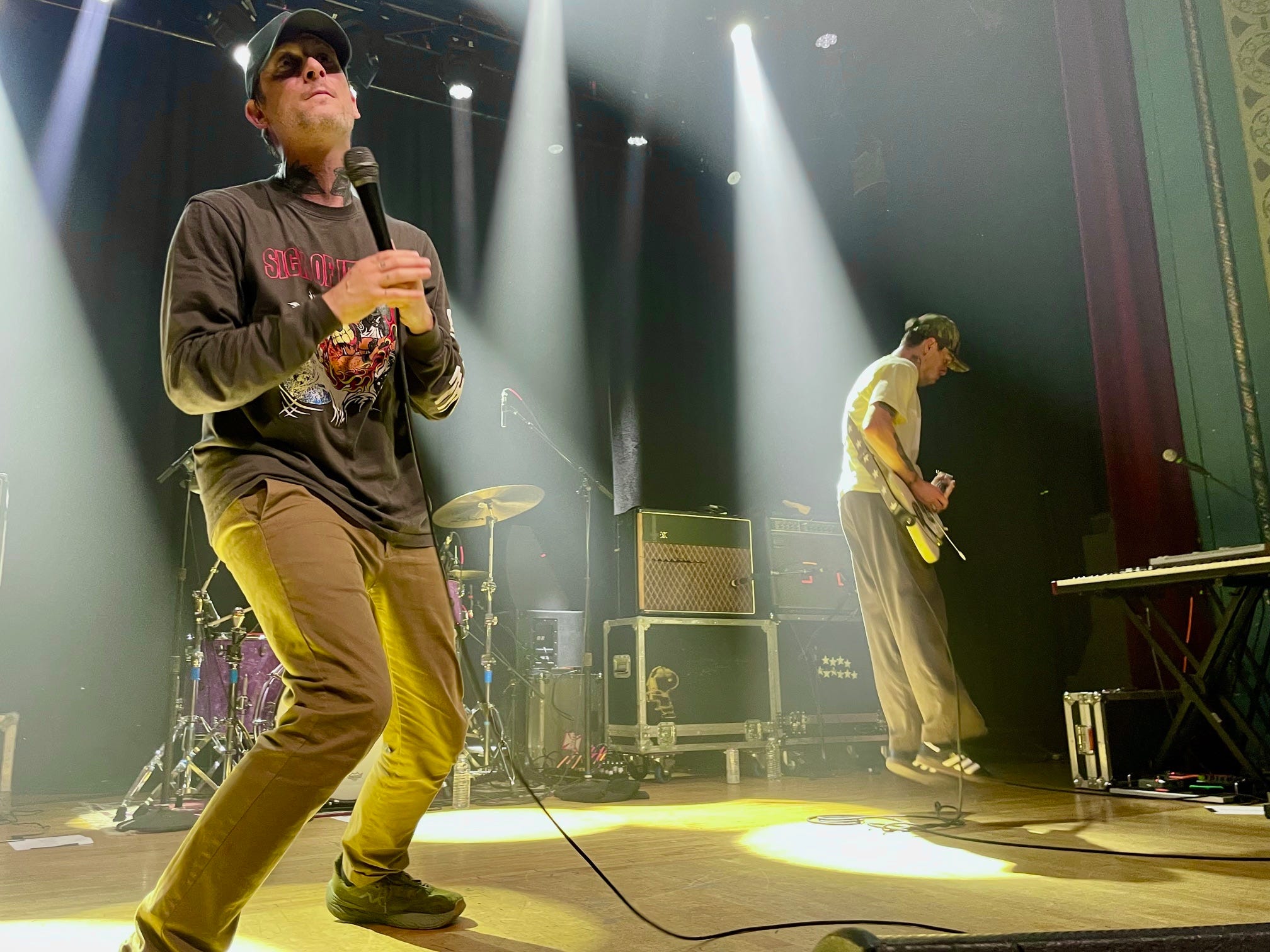
I have a general rule where I try not to interview the same people repeatedly. But I looked back and it’s been 17 years since I interviewed Patrick Kindlon, so I’ll give myself a pass. Plus, that also seems like an extraordinary long amount of time, but I guess we have known each other for longer than that. I’ve always found Patrick to be a very interesting person, and a pleasure to be around. Some people get frustrated by his frequent tangents, or an almost seemingly default setting towards being contrarian, and on paper it may come off that way. However, I’ve always found within these conversations he does so with a great degree of self-deprecation and levity, and I always take something of value from that. His resume’, I guess first and foremost, leads with being the frontman of the band Drug Church, who have steadily risen in stature to become a well-recognized and heavily touring group. But Patrick has also been a part of Self-Defense Family (who evolved out of his earlier very prolific band End Of a Year) for well over 10 years, who have an exhaustingly vast catalog of records despite always being a very part-time band. Add to that another highlight of being a well-respected comic book writer with titles published by Image and Black Mask, and co-host of the highly entertaining hardcore-punk centered Axe To Grind podcast it’s rather daunting to imagine how he has time for so many things.
It also makes for a good conversation with a person who grew up around Albany, New York but, by all accounts, is essentially a citizen of the world at this point. So yeah, Drug Church is the header for this interview because that’s who I went to see at the show. But there’s always a lot to catch up on with Patrick and I genuinely enjoy hearing about it.
So you now live in Tasmania. That is a very interesting, very remote place. Tell me a bit about that.
So for people at home Tasmania is a state in Australia. It’s not Tanzania, which is a country in Africa. People often make that mistake. It is often forgotten about by the rest of Australia. It is, in many people’s view, not a desirable place to live because it’s quite chilly compared to the rest of Australia and it’s a little behind in healthcare, a little behind in education, it doesn’t have as many opportunities for employment as some other places. It’s a small place.
And it’s an island.
And it’s an island. You can fly for an hour and a half, or you can take a nine-hour ferry. It’s your choice. But it’s a very, very beautiful place. I like the people quite a bit. It’s a provincial, sort of locals spot. I live in a small town outside of Hobart. I personally love it. My wife is going a little stir crazy because it’s kind of slow. But I’m on tour 100 days a year so when I’m home I like the slow. Like, I walk to a general store every day. It’s that type of thing.
Well, for as long as I’ve known you you’ve always been pretty nomadic. You don’t lay your head down in the same place for very long.
When I meet people who are like, ‘I’m a New Yorker, and that’s all I’ll ever be!’ it doesn’t sound like you’re doing well. It sounds like you’re a little crazy. It’s a really big world. You gotta taste it to know how it tastes. You go to one place, you don’t have to live there for the rest of your life, particularly if your back works and you can lift things you have options.
When I met my now wife and we discussed where to live Australia was fine by me, it seemed like a totally fun adventure, and when she said ‘how do you feel about Tasmania’- because we originally lived in Perth- it’s kind of a long story but I had no leverage because I was banned from the country at the time. I’m just glad my wife was willing to stick with me, but I said ‘yes, when I can get back in that country Tasmania sounds good.’
I’m really glad for it. My wife is now having second thoughts, but I really love it. It’s a lot like the Pacific Northwest in some respects. It’s a very beautiful place. I talked to someone the other day who had never left the area. I don’t mean the island.
You mean the town.
Yeah, pretty much. You do encounter a little bit of that. And you do encounter a bit of a brain drain because once kids there turn 18 they all leave and go to Melbourne. But I find it charming as hell.
But you have been everywhere. So what are some of the best places?
The best place in the United States is San Diego. Places in Europe I’ve really enjoyed, Spain is hard to beat. Italy is great. My family is a little Greek so I like Greek stuff. South of France, perhaps.
I haven’t done a ton of Africa. Well, fake Africa, no offense to the Egyptians but they don’t even really consider themselves African. So I haven’t seen enough of Africa to comment.
South America I really, really liked Buenos Aires, it was very pretty. Santiago, Chile was also interesting.
Again, in the US, San Diego and Charleston, South Carolina are the greatest places.
In Asia I’ve only done Cambodia, Thailand, Vietnam, and Indonesia.
Oh, that’s it?
(laughs) Well, there’s a lot to miss! Oh, I went to Japan too. Japan was totally fantastic, I don’t know if I would want to live there. I really enjoyed the chaos of Cambodia, but I thought Vietnam had a very nice energy and the Indonesian people are really, really charming. So that’s my world review.
How does Tasmania stack up against them all?
Tasmania is top 10 for sure. It’s not quite as beautiful as the Swiss Alps, or something like that. And it’s not as beautiful as Tennessee. I feel like Tennessee is one of the most beautiful places on Earth. But it’s really green. It feels like it’s alive everywhere. It has a real deep charm to it. So I would put Tasmania top 10.
But living there obviously makes everything else you do complicated.
Oh yeah. If I want to leave my house to come to the United States to play music the band starts at a deficit of $3500 just so I can get there.
That’s rough. But it says a lot about the band. I remember when Drug Church started and we were talking about it and you were kind of brushing it off that it was just a project, and you wouldn’t do much of anything with it. So now it’s the thing that probably takes up the most amount of your time.
Yeah, as crazy as it sounds you could call the band that we only intended to do a demo and break up a career.
You also seem to be a person that has always kind of just fell into a thing, or were invited into a thing, rather than being the person who starts a thing.
That’s true. At a young age I was the most verbal guy so they would say, ‘you’re the singer’. And then I became a singer for the rest of my life. I never got very good at it. It’s a weird thing they’re going to be putting on my epitaph. ‘Never truly mastered his vocation of 30 years’. (laughs)
You never really want to see yourself as a passenger, you’d rather be the commander of your own destiny, but the fact is I have fell into music quite a bit. And now, by virtue of being the singer, you’re seen as the band leader. So even if you don’t want that role people outside the band will put you in that position.
Switching things a bit, how did you get into writing comics?
That was actually Matt Rosenberg. Some people in music will actually remember that he was the guy who did Red Leader Records. He put out records by Strike Anywhere.
He did some stuff.
He put out a lot of people’s first records before they all left him for bigger labels. So he and I would talk because we were acquainted through music, and we both had an interest in comic books. We were both approaching 30 and said the right thing, which is, ‘why don’t we just try it?’ Time is slipping away from us, let’s go for it. So we did.
I’ve been reading comic books since I was two, and throughout most of my early adolescence I had wanted to do it as a career. But I didn’t even know how to approach that. So it was good to have somebody to motivate with. It put me in the position of having some structure to the thing I was trying to achieve. Having someone else to say, ‘hey, what did you do? Did you get something done?’
Matt is very good at networking. He got us in front of some people. He got us some early opportunities. Those opportunities spun into other things.
In careers, as well as in life, there’s a lot of people that have survivor’s bias. They believe that because something worked out for them that that’s how it would work out for anyone else. You find this in music a lot. Bands that are successful believe that’s how it had to be. They were just so talented and so driven that there was no other way for it to possibly go. But that’s obviously just not true. Like, the guy from OnlyFans just died….
OK, I’m waiting for you to tie this altogether. Let’s see where this goes.
Maybe at one point that dude had the same feeling of ordained success from heaven. The same thing that some people in music feel, or some people in business feel. When everything worked out for you in such an incredible way that you never worked out that your gene sequencing, your RNA, you wouldn’t develop cancer at the wrong time to achieve your dreams.
This idea that fate arrives you at success… I don’t buy that. I’ve just seen too many really talented people who, just as driven as anyone else, get in car accidents that rendered their spines not operable. It’s all luck. And anyone who thinks it’s not is suffering a case of ego.
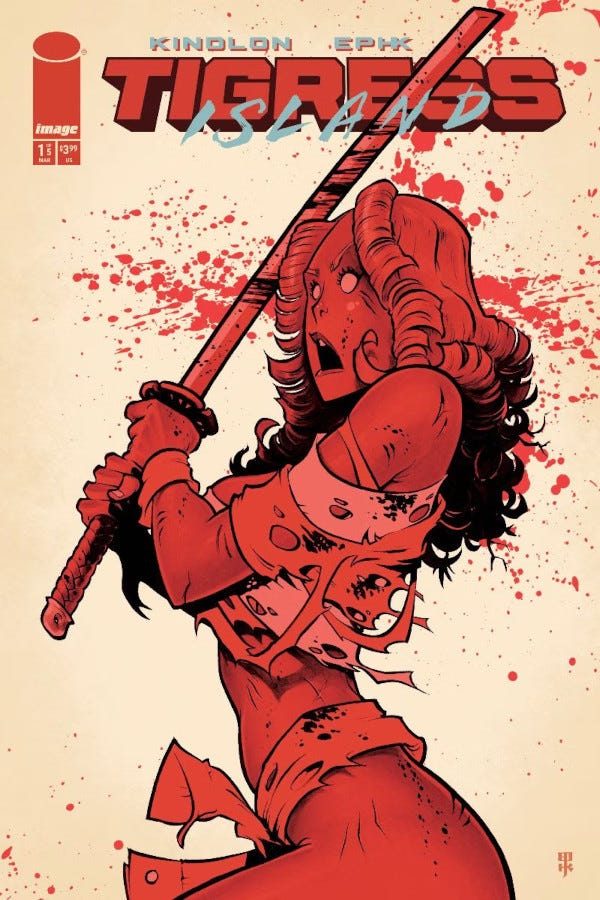
A recent title written by Pat Kindlon
But I imagine writing comics works well for you because it’s something where you don’t have to be tied to a location in order to do. You can tour all year and still write comics.
Yeah, certainly. It’s also easy when you’re passionate about something. It’s something I’ve loved since I was a child. This sounds strange, but even things like my sexual identity are formed by sequential art. I find comics much sexier than I find pornography. Obviously pornography is arousing, but there is something psychologically very stimulating about comics. An erotic comic is more tantalizing and titilating to me, personally.
So there’s things like that you don’t even think about until you’re an adult, but when you have these interests…. like if you did ballet as a young child there’s an excellent chance it will inform the way you move for the rest of your life. That’s the way comics are for me. It became an easy thing for me to fixate on, still is. Right now, because I had a little bit of success in the last couple years there’s a lot of moving parts, and you really feel like a publisher because there’s always spinning plates. There’s always something happening. That’s not really who I am. My brain moves slow. I’m not an organized person of any sort. So for me to do something like this I have to love it, month after month. It’s a bit like music, not to be corny about things.
For example, my wife has a perfectly respectable career in administration that she’s good at. She doesn’t see what I do, necessarily, as a job, or as work because I enjoy it too much for it to be work. You can understand someone that works in administration would look at someone who gets on a stage for 45 minutes and say ‘stop with the bullshit. That’s not work’. That’s how I feel about comics. It’s a really fun thing to do.
Does going the route you’ve gone with comics make it more difficult to sell a series to a publisher versus signing up to write for a series that’s already known?
I should be honest, I have alienated myself quite a bit from the big publishers.
Image is a pretty big publisher.
They are the largest of the creator-owned companies. I’m very grateful for the relationship I have there. But I’ve been very critical of the product of Marvel and DC, and that doesn’t really ingratiate me in any way. I don’t want to say I’m blacklisted, or think I’m so self-important to be blacklisted, but I don’t get the phone calls. I’ve taken a couple of meetings at these places. I’ve been promised books, but then editors leave.
These companies put you in a weird position because if you’re critical of them people will see that as the top of the pile and that you’re bitter because you’re being critical. Respectfully to my colleagues that work for those companies I don’t think anyone is doing the best work of their careers at those companies. And if you are it’s a little alarming. It’s totally fine to work for those companies. There’s a lot of opportunities that exist, but you also have to be doing your own thing.
This is semi-related but it seems over the last few years there’s been a number of people connected in some way to punk and hardcore that have gotten into writing comics- Gerard Way, Matt Rosenberg, Becky Cloonan, Michael Conrad, yourself.
There’s also other counter-culture, maybe not punk/hardcore, but counter-culture people who are in it as well. Aubrey Sitterson is a fellow that does work. I haven’t seen him lately, but Matt Miner is a proper Earth Crisis type guy. His work often has a sort of animal rights angle to it. And also, he’s not a hardcore-punk guy as you or I would define it, but that fellow from Say Anything, Max Bemis has written comics.
People search for crossover between these two things, but the reality is I don’t see any meaningful crossover between being into punk music, and writing for Disney. Again, it doesn’t mean it’s wrong. I’ve watched Disney products over the last ten years, I’m not judging. I’m just saying there’s no significant overlap.
I can say this: when you are working in creator-owned comic publishing, in any capacity, whether you’re doing self-publishing or going through a company like Image, there is a healthy DIY aspect to it.

So let’s get back to music. You had this thing you would talk about sometimes regarding the way you write lyrics where you wait until you’re in the studio to write everything. Do you still operate under that principle?
Yeah, sure. I’m really struggling with the new Self Defense record because I have so much time with it. It’s done. But I still have to go into a studio and stress to actually get good lyrics.
Is that the way you prefer it?
Yes. I prefer it that way.
You don’t show up to the practice space and hash out ideas while they’re writing songs?
No. What the hell am I going to offer? I don’t know how to play an instrument. I don’t know the songs until I go into the studio to record the lyrics. I have to write to what exists.
So they don’t even send you demos.
No.
That’s an interesting way to work. Why do you prefer it that way?
It’s the stress of actually having to perform. Like the other night I didn’t know any of the lyrics on the first night of this tour. We were playing songs I didn’t know at all. I spent four hours before we took the stage listening over and over to the same songs. I was convinced I didn’t know any of them, and the second we took the stage some Pavlovian thing took over and I knew it. But I needed the stress of, ‘oh, should I go on stage in a couple hours and I don’t know these songs?’. It’s not for everybody. Stress hits some people in a certain way that they don’t respond well to.
I’ve always compared it to soccer. You go on a field and you play soccer, but you don’t get to revise the job you did in that game.
You’re in the moment.
Yeah. So that leads me to think you don’t come up with at least themes, or ‘maybe I’ll address this stuff on the next Drug Church record’. You just show up and come up with it there.
Yeah.
I had been thinking about the Drug Church lyrics for some songs recently and maybe I’m off, but it feels like compared to earlier records where it often felt like you were telling stories about other people, whether they’re fictional or real, there’s more songs recently where you’re working out something about yourself.
Specifically, I think of ”Peer Review” because I think it’s a very interesting story based on personal things.
The story part, I don’t know why that happens more with Drug Church instead of Self Defense. You’d think with Self Defense we have these repeating parts where it would be easy to sort of novelize. But for some reason the Drug Church material lends itself to these stories. It’s just what comes out.
But it’s usually a mix. And those songs where it sounds like I’m talking about someone else it’s usually some reflection on me. I don’t think I’m clever enough to completely detach myself from a story.
The very newest song we just released is, from my standards, incredibly autobiographical so there’s no story. It’s just me.
I guess it’s been a mix for awhile, but you’re probably right. It’s arcing towards immediately personal.
I also like the idea behind “Detective Lieutenant”. I’m sure a lot of people take issue with it, but I really like the way in which the topic is addressed in the song.
Here’s my attitude on this- people make it a binary between ‘can I separate the art from the artist’. You either can, or you can’t. I think those are both broken binaries because what of the idea that perhaps the person’s bad behavior, or whatever they’re being accused of, informs their work. You don’t need to separate these things because they can inform each other in such a way that you perhaps get a bigger picture of this damaged person. And not for nothing, but I think it’s genuinely depressing when somebody endeavors to separate someone from the only thing they have to offer the world.
What I mean by that is I meet a lot of musicians. For better or for worse it’s my job now. I meet a lot of people who have nothing to offer other than this music that they make. They’re damaged people, they’re not ambitious, and they’re just people. And people have their problems and their foibles. So this idea that because of behavior we don’t approve of, or is generally reprehensible, that we have to divorce somebody from the only thing that we knew them from is strange.
For example, Dave Grohl had an extramarital affair. I don’t understand how that is anybody’s business on any level. That’s between him and his wife. But let’s say you’re a person that finds extramarital affairs to be particular onerous and immoral. Maybe it broke up your family and you have a real opinion on extramarital affairs. But I’m going to assume you didn’t listen to the Foo Fighters because they’re good to their wives. I assume you listen to the Foo Fighters because you like bad music. So when you find out that somebody did not fulfill the thing that you never went to them for why is that a problem?
Nobody is able to provide an answer to me for that that sounds at all convincing. I didn’t go to these musicians for their interpersonal relationships. And if their interpersonal relationships are dogshit I don’t know how that is supposed to divorce me from the thing that I did go to them for.
I have my own feelings around the subject matter of that song, I just think it’s presented in a way that opens it to discussion.
Listen, people are very emotional about things for good reasons. If you have been mistreated in specific ways it’s no surprise that you learning about another person behaving that way is going to incite these feelings in you. It’s a very natural thing! I wouldn’t seek to take that away from anybody. But there’s a second layer of indignation you see from people that is less personally felt, and more socially-channeled. There’s a purging of people that have what I’d call ‘none of my business-isms’. Like the Dave Grohl thing: cheating on your wife is bad behavior, that’s the way I feel about it. Maybe there’s people who feel different. But what’s difficult for me to reconcile is owing the world an apology for things that are purely interpersonal. Dave Grohl feels like he needs to make a statement to the world. That’s strictly between him and his wife. This idea that he needs to apologize to strangers is not very well-balanced thinking.
So Drug Church tours with a wide variety of bands, and Self Defense is not a hardcore band in any sense of the word. So do you feel that by maybe being co-host of Axe To Grind podcast, which is a very hardcore outlet, keeps you tied to that world? In another way of asking, what keeps you tied into hardcore?
I don’t know. I thought about this the other day and I came to a realization. You can only like what you like and people that force themselves to like things that they don’t are wasting their time. We were just upstairs in the venue talking about different bands that are popping right now and I hate every single one of them. I never want to sound ignorant, like I only like one thing. But the reality is there’s only like two types of music where I will give any new thing of that type a shot. Hardcore is one of them. And I don’t know why that is, other than an interest I developed when I was 15 (laughs)
It just sticks.
It just sticks and I don’t over-examine it too much. But doing the podcast does help me keep up with the actual news of the day, which is usually pointless gossip. But the news of the day is that there’s new music, or this tour is happening, what’s bubbling, is this what people are into, whatever. It’s a bizarre thing. Self Defense was never a hardcore band, but it might as well have been because that’s all we ever play with! Sometimes you get grandfathered in to these circumstances. Drug Church is a different situation. I always want to play with hardcore bands because as a matter of personal preference I want the show, from the first band to the headliner, to be raising the energy in the room. My bandmates like to have a show where there’s peaks and valleys, and dynamism in the respect that maybe we put a slow band on, between us and another band, and I have the complete opposite take. I hate it. I really hate it. That’s no disrespect to slow bands, I’m in one.
I don’t think a show needs to tell a story, you know what I mean? ‘Let’s make the show a really mixed bill so that the third band in everyone falls asleep simultaneously’. I don’t find it to be a good fit for Drug Church because at our best moments we’re at go-go-go. That’s why I always prefer to play with hardcore bands because those are the bands with that energy.
When we’re putting a tour together I’ll be the one say to say I need something…. it doesn’t need to be a proper hardcore band, it can be hardcore-adjacent, post-hardcore, but it has to have energy. Maybe it’s laziness on my part. I don’t want to be doing twice the work to get a crowd into the mood when I could have just had some support to do the job.
So that’s part of what keeps you tied in?
That’s part of it, for sure. My bandmates are paying attention to some of the indie stuff, the post-shoegaze, whatever. For my money I want to just tour with not dyed-in-the-wool hardcore bands-
Not Drug Church and Merauder.
Merauder I could almost justify because they’re still doing occasionally interesting things. But if you’re doing a straight up demo-core, youth crew-inspired sort of thing that has no angle to it that makes it more interesting you might be a great band, but it’s hard for me to where it fits in the shows I do. You’re right though. The last couple years we have been playing with more hardcore bands. We’ve gone out with Turnstile once or twice. They’re a great band and great people, but you can’t play with the same people all the time. I love the band Soul Blind. I’d take the band Soul Blind anywhere, on any tour, but we’ve gone out with them two or three times. So just by necessity you find yourself going, ‘what else is out there?’
I also see people commenting about this as well. But for the health of your band, you can’t just go out with the same five bands all the time. You can’t. In some ways it forces you to open up your aperture a little bit and try to experience other things.
We’re on tour with White Reaper and that’s not the type of music I reach for. But in trying to find interesting bands to tour with you occasionally trip over one and say, ‘oh, that’s quite good.’ They’re not trying to marry themselves to a specific subculture at all. They’re doing the hard thing and playing rock music very loud.
Just to close out, you have been doing this a very long time. We’re getting older. Does it get harder?
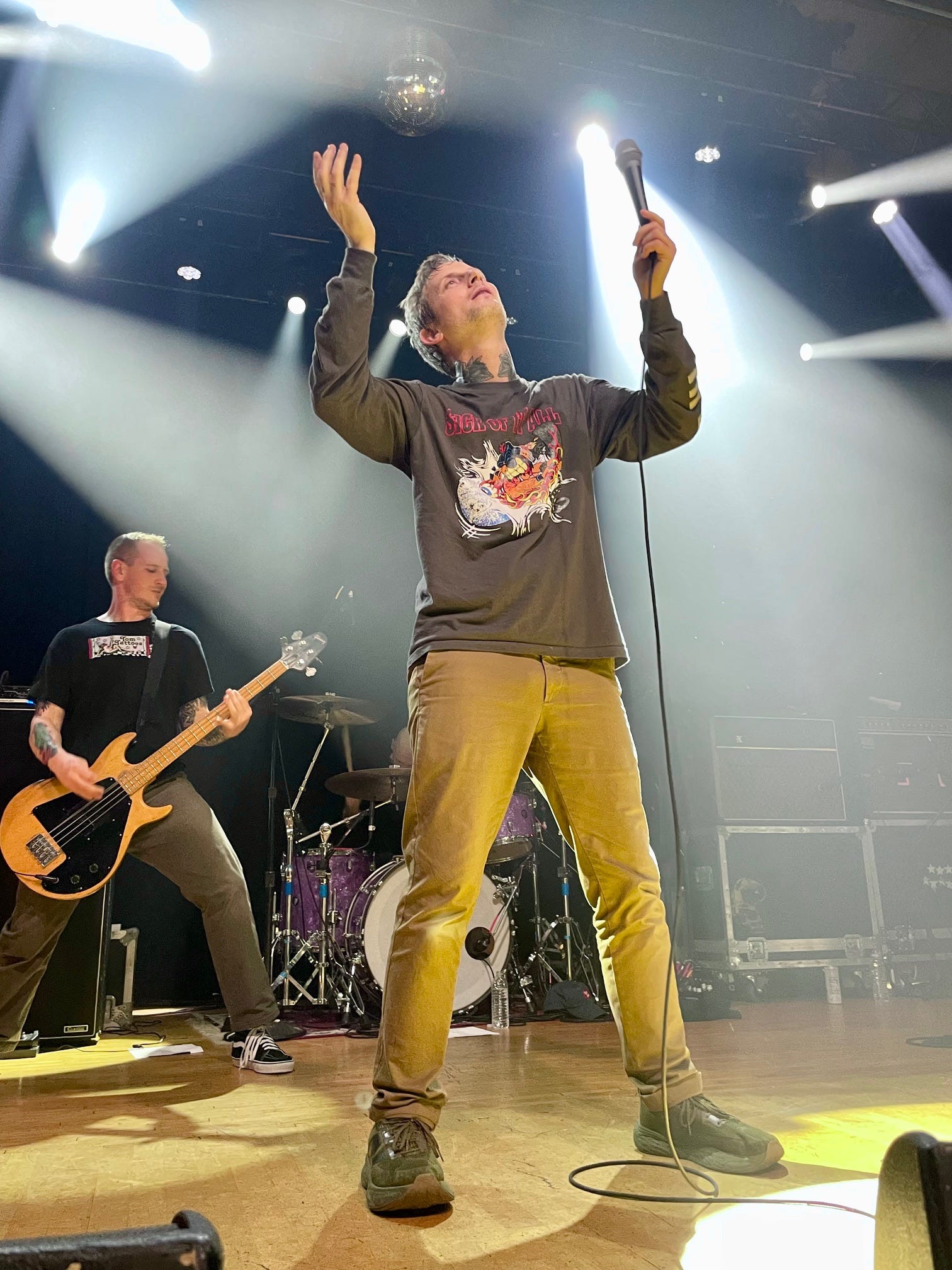
Physically, no. I’d like to give a shout out to the band Engineer. You put out one of their records. I booked them several times when I lived in Albany and they’re a really good band. The thing I learned from watching them, a band that a lot of people reading this might not remember, is that you don’t have to be doing the most in order to be impactful on stage. Now that I’m slow and fat I can move in a different way to keep up my interest, and keep up other people’s interest. You don’t have to be jumping around, per se. I think I’m still entertaining, you be the judge. I’m just slightly slower.
I’ve only thrown my back out once and that was from doing work outside of music. But there are guys younger than me in hardcore bands that are really struggling with back problems. It can come for you any time, it’s really quite scary. If you just take the wrong turn on stage you can kick something up. Sorry everybody if this is old guy corner, but it will come for you someday. I promise you.
But is getting old hard? I think it’s easier in some respects. We played a venue the other day, a really fun venue to play music. A not-fun venue to not play music. What I mean is that the green room was so discouraging for a grown man to be sitting in that I was laying on a table, starring at the ceiling saying ‘I think it’s time I worked with my hands, I’m watching some guys on Instagram doing cleaning work and it looks fun. Maybe my wife and I could start a cleaning business, we can clean the Air BnB’s in the neighborhood.’ I’m in here thinking about my options because this room is so depressing that it’s trying to forcibly eject me from the thing I’ve done for 25 years! So yeah, those moments happen. But I’ve determined there is something wrong with me because those moments come very infrequently, where as for a lot of people over the age of 40 they come all the time.
And I should mention, this is just being fair in how I balance this conversation- to be paid to do something that is so remarkably fun I do have to, on occasion, stop and realize that it’s a privilege. It’s true that I think I make good music and I’m supposed to enjoy it, and you’re supposed to pay for things you enjoy. But then I pause and think there’s a whole lot of people making really good music who are not able to be doing this thing that I’m doing for whatever reason. And it is a real privilege. I had this moment, in real time, while on stage where I was really grateful for all these people. It’s such a nice thing that they still enjoy what I do. You have to have some gratitude for a rare opportunity in life. Not to be maudlin, but a lot of people get zero validation. I get emotional about it. You meet people that are inspiring not because they tell you you made a difference in their life- that’s nice, don’t get me wrong. But what’s really inspiring is when you see a kid develop an interest in a thing, you know what I mean? Maybe they will think your band is lame in two years, but you’re helping motivate someone to express themselves.